

Story 16 - May 19, 2026 - U.S.

Just back from: The Climate Pledge Beauty Summit

Retail Sustainability

By Wynne Pickus

/

Fashion and Beauty Lead, The Climate Pledge

The Climate Pledge's second annual Beauty Summit in Los Angeles hosted beauty industry leaders for a day of practical sessions and honest conversations about product innovation and packaging challenges, and how we can work together to solve them.

Seventy-five participants from 46 brands attended The Climate Pledge’s Beauty Summit co-hosted by Saie, one of the first beauty companies to sign the Pledge. The event addressed sustainability challenges ranging from supply chains and environmental policy to certifications and packaging, each representing a part of the path toward reaching net-zero carbon emissions by 2040. Convenings like the Summit help companies identify shared challenges, accelerate solutions, and strengthen collaboration across the industry. Inspired by the day’s events, six beauty brands signed The Climate Pledge, underscoring the value of collective action.

Read on for a glimpse of the day’s programming.
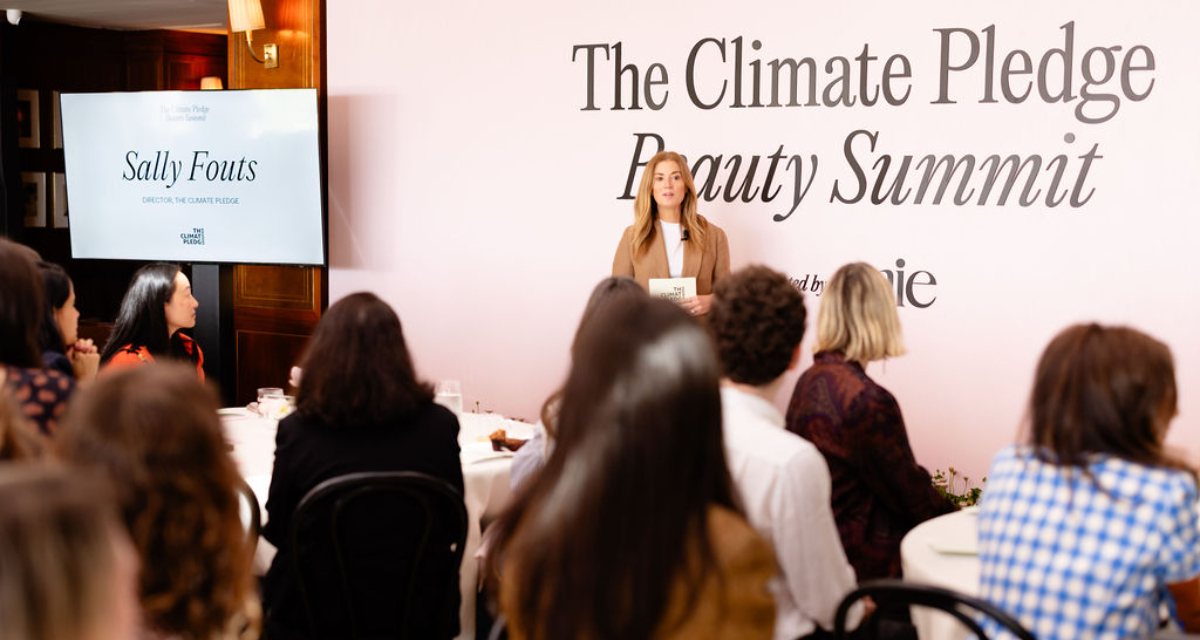
The opening keynote at Beauty Summit introduced The Climate Pledge, its mission, and its vision for the future.

Opening keynote address

The opening keynote presented by Sally Fouts, global director of The Climate Pledge, highlighted the purpose and momentum behind the Pledge, starting with its founding in 2019 with Global Optimism to its growth across the private sector. The Pledge now has over 650 signatories committed to reaching net-zero carbon emissions by 2040.

Fouts highlighted the reporting requirements and benefits of joining the Pledge, while emphasizing the opportunity for beauty and fashion brands to collaborate on shared climate challenges.

Fouts also spotlighted the collective impact that cohorts and joint action projects can make, such as Laneshift in India and Brazil and the Electrifying Drayage Alliance.

Her hope for the Pledge is that it holds firm on its core commitment of reaching net-zero carbon emissions by 2040, while giving companies room to find their own path. In her words, the Pledge should be “stubborn on the vision, flexible on the details,” and a catalyst for private sector decarbonization.

She wrapped up the session with a quote from the children’s book Kamala and Maya’s Big Idea: “No one person can do everything, but everyone together can do something.”

MARA Beauty signed The Climate Pledge during the Beauty Summit.

Unlocking the value of Climate Pledge Friendly

This session introduced Climate Pledge Friendly—a practical and actionable way for beauty brands to identify, verify, and communicate credible sustainability features to their customers.

Beauty consumers are increasingly looking for proof behind sustainability claims, with third-party certifications playing a central role in building trust.

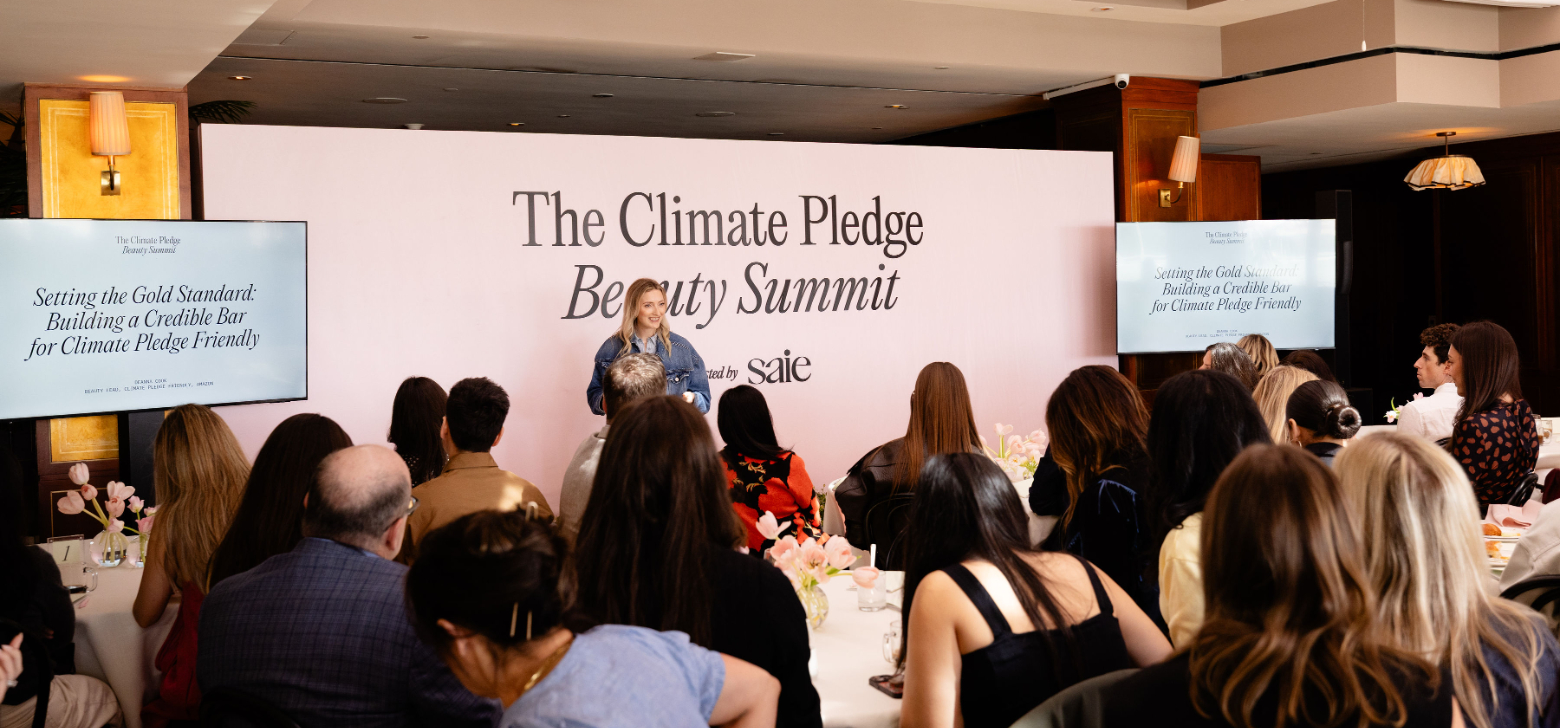
Deanna Cook, beauty lead for Climate Pledge Friendly at Amazon, explained that it is not a certification itself, but a screening process that evaluates credible certifications and applies product-level requirements before surfacing qualifying products to customers.

Cook closed with a clear roadmap for brands preparing to participate in Climate Pledge Friendly in 2026: identify relevant sustainability features such as safer chemicals, carbon impact, and worker well-being; choose an aligned third-party certification; complete the certification process; submit data to Amazon; and amplify the Climate Pledge Friendly badge once verified.

An attendee captured the lessons from a global leader in supplier decarbonization during the session “Supplier Engagement: Acting Alone vs Acting Now.”

Accelerating supplier engagement together

Using the “Tree of Supplier Engagement” framework, Emelissa Bayulot, global leader for supplier decarbonization at Amazon, outlined how brands can build a durable approach to supplier engagement, from identifying high-carbon risk categories and geographies to empowering procurement, legal, and finance teams to lead supplier conversations.

Beauty brands can accelerate supplier engagement by working together rather than approaching shared suppliers in isolation. Collective action matters, especially as many beauty brands share the same ingredients, manufacturing, and packaging suppliers while facing similar challenges around Scope 3 emissions and complying with policies like Extended Producer Responsibility (EPR), put in place to encourage manufacturers to design more sustainable products and reduce waste.

Attendees collaborated during the “Small Format Recycling Infrastructure Coalition” session.

Rethinking small-format recycling

Participants in this session explored how small-format beauty packaging, often under two inches, presents a major recycling and compliance challenge as EPR legislation expands across the U.S. and small-format products are often too small or too light to be captured by standard sorting equipment.

Speaker Scott DeFife, CEO of the Small Format Recycling Coalition, emphasized that small-format packaging should not be treated as waste, but as a recoverable stream of glass, metal, plastic, and fiber that needs better sorting infrastructure, buyers for recovered materials, and data that proves it works.

His presentation highlighted the coalition’s work to bring brands and industry partners together to fund pilots, measure the recovery of recycled materials, and build evidence for recyclability pathways under California SB 54—a bill passed in 2022 outlining the requirements for single-use plastic reductions, recycling, and reuse.

The event closed with the session “Simplifying Compliance for Climate Pledge Signatories.”

Tools to tackle packaging compliance

Speakers Meg Hibert, director of business development at RePurpose Global, and Lauren Singer, head of sustainability and impact at Saie, outlined the core compliance challenges brands face today. Some of those include varying state requirements, complex material category definitions, fragmented supplier data, misclassification risk, and limited visibility into future EPR fees.

The presentation highlighted how RePurpose Global helps brands centralize packaging data, assess reporting obligations, generate audit-ready reports, forecast fees, and evaluate packaging tradeoffs through a scalable compliance platform.

A case study from Saie showed how brands can move from manual data collection to a more streamlined compliance process, including SKU-level packaging inventories, reporting support, and preparation for future obligations.

An outdoor lunch and networking event was put on for guests following the Beauty Summit sessions.

Beauty is one of the fastest-growing sectors of The Climate Pledge, with 30 brands already signed on—and convenings like this one are one of the reasons why. No brand can decarbonize alone. The most durable progress comes from companies willing to share data, align on standards, and build solutions together.

Find more coverage of The Climate Pledge Beauty Summit on InstagramThreads, and LinkedIn.

All photos taken by Marissa Joy Photography.